Psychology
In my system, psychology is divided into three large directions.
General Psychology
General psychology answers the question: how we all solve tasks.
For this we have the model of the task conveyor.
There is an external conveyor: tasks come to a person one by one. For example, a student sits at an oral examination, the teacher gives him tasks, and we observe how he deals with them.
There is an internal conveyor: the task enters the person’s head, is copied, waits in a queue, receives the energy of warming-up, and moves to the operating table.
Read more:
Differential Psychology
Differential psychology answers the question: how we differ from one another when we solve tasks.
For this we use three models:
- Warming-Up: how a person enters a task and receives the energy of the needed type.
- Encodings: in which internal languages a person receives and processes information.
- Levels: what complexity a person is able to hold and solve.
Read more:
- Warming-Up - Encodings - Levels
- Warming-Up
- Encodings
- Temperament
- Laughter, tears, procrastination
- One key that opens five doors
Age Psychology
Age psychology answers the question: how a person changes with age.
According to our observations, every three years the next level opens before the growing person as a possibility.
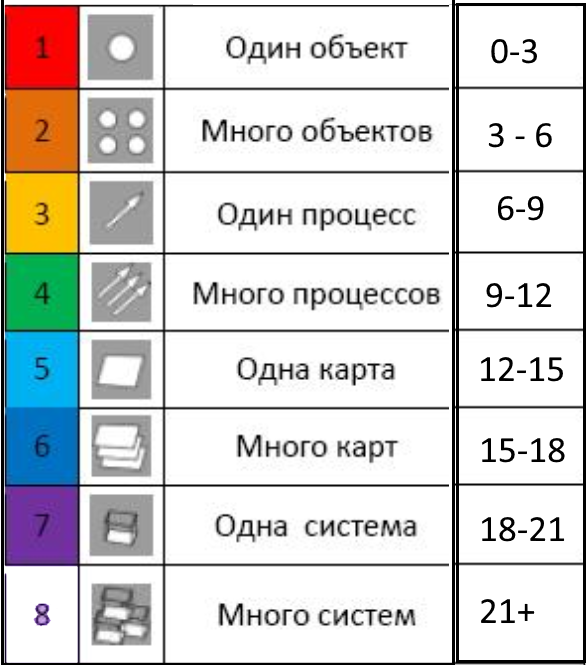
| Level | Structure | Age |
|---|---|---|
| 1 | One object | 0-3 |
| 2 | Many objects | 3-6 |
| 3 | One process | 6-9 |
| 4 | Many processes | 9-12 |
| 5 | One map | 12-15 |
| 6 | Many maps | 15-18 |
| 7 | One system | 18-21 |
| 8 | Many systems | 21+ |
Read more: