The Humanities: Two Axes, Five Domains, and FSHA
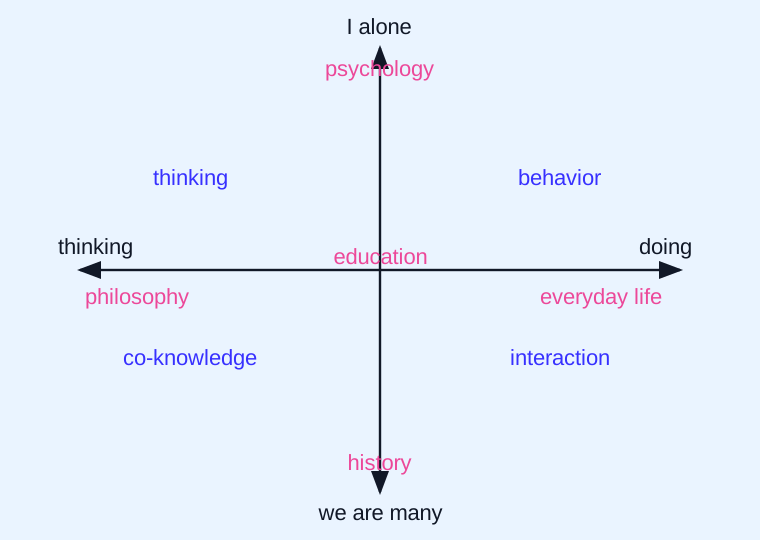
The map shows the relative position of problem domains. There are five such domains.
Why is this needed?
If we want to unite data about human beings obtained in different studies, we need to know how these studies are grouped and what the relative position and boundaries of these groups are. These groups are the problem domains.
At the same time, we examined the way a human being exists in the world - human activity - and discovered that the four sides of this activity have their place on this plane as four directions:
- thinking;
- co-knowledge;
- behavior;
- interaction.
This is how the term FSHA - four-sided human activity - receives precise content.
Now, if we study thinking, for example, we must understand that it belongs both to philosophy and to psychology. Co-knowledge belongs both to philosophy and to history, and so on.
Note
History is understood in a broad sense. First, it includes the present time. Second, it includes sociology, political theory, cultural theory, and all studies of social processes in general.