Encodings
People process information in different ways.
The question is how to structure, that is, classify this difference. I propose the following model.
A person is like a computer in a network.
We know that a computer has protocols of different levels. In our case these are:
- Low level: small units.
- Middle level: medium units.
- High level: large units.
The specificity of a person is that in each row there are systems that compete and partly replace one another.
| Encodings | |||||
|---|---|---|---|---|---|
| Low level | ear | eye | hand | smell | taste |
| Middle level | text | picture | scheme | ||
| High level | images | meanings | scenarios |
The terminology needs clarification.
Picture: a person remembers the scene in all its details.
Scheme: a person immediately discards unnecessary details and stores the material in a simplified form, while preserving the essential parameters.
Text: the situation is described in natural language. This linguistic description is stored and processed. By the amount of stored detail, this is an intermediate variant.
And here is where “images - meanings - scenarios” come from.
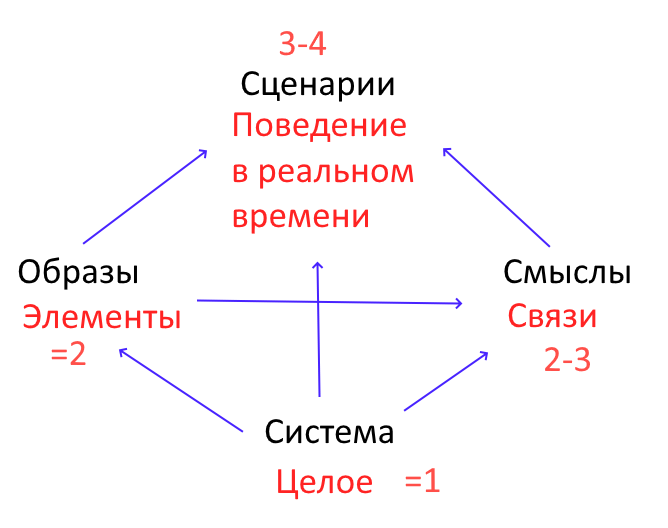
Images: elements.
Meanings: connections.
Scenarios: behavior in real time.
Together they give the system as a whole.
See also: